One of the most well known eclipse periods is the Saros. After 18 year and 10 or 11 days and 8 hours, an eclipse repeats. E.g. after the total eclipse of 11 August 1999 the next one in this series will be 21 August 2017. As the eclipse happens 8 hours later on the day, it will take place approximately 120° to the West. So the 2017 total eclipse will be visible from the United States of America.
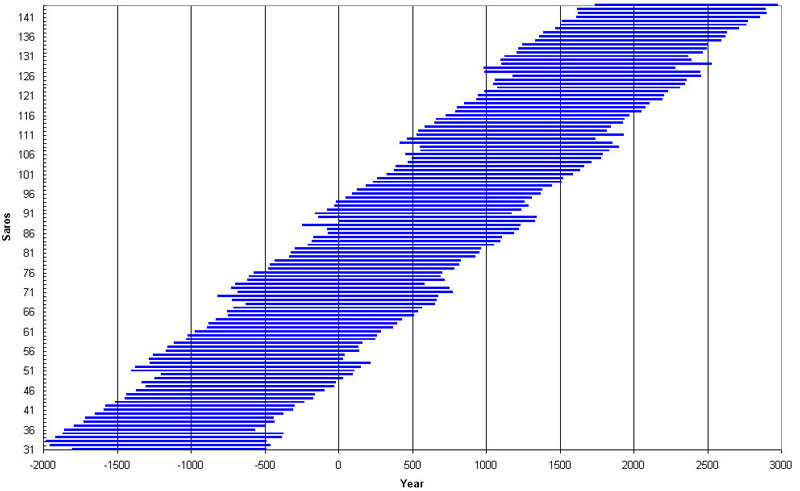
A new Saros series starts as a small, or often tiny, partial eclipse. The
Saros series 140 started on 16 April 1512 with a tiny eclipse of magnitude
0.0003, whereas Saros series 152 started on 26 July 1805 with a small
eclipse of magnitude 0.1407
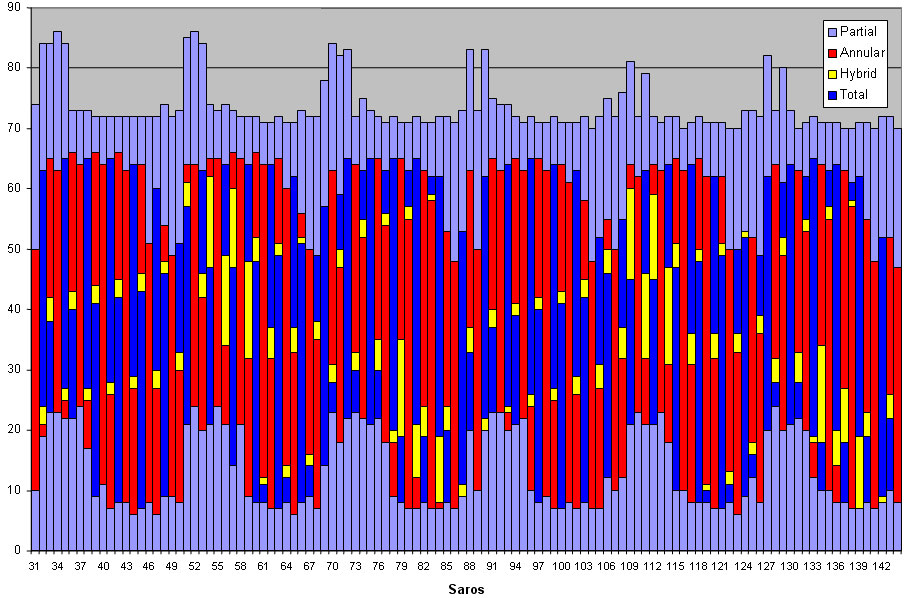
If we use a letter for a series of eclipse, e.g. PAP stands for series of
partials, followed by series of annulars, followed by series of partials,
the following sequences do occur: PAP, PTP, PAHTP, PTHAP, PHTP and PTHP.
Sequences PHP, PATP, PTAP, PHAP, PAHP, and sequences with 2 A's or 2 H's do
not occur in the sample considered.
ddd